
AN ILLUSTRATED SHORT STORY · 05
A Cemetery Worker Finds an Envelope Under a Bench During His Rounds
On his morning rounds, cemetery worker Idris Rahman notices an envelope held beneath a bench by a stone. Inside are forty £20 notes and an order for a burial the following morning. The person named on the order is Idris himself.
He looks for the source of the paperwork, but the investigation uncovers more than a clerical mistake. A voice he recognises from his own childhood calls for help, and the cemetery’s records no longer agree with what he knows. In this fantastical crime mystery, Idris must discover who prepared the order before the scheduled burial.
Read chapter one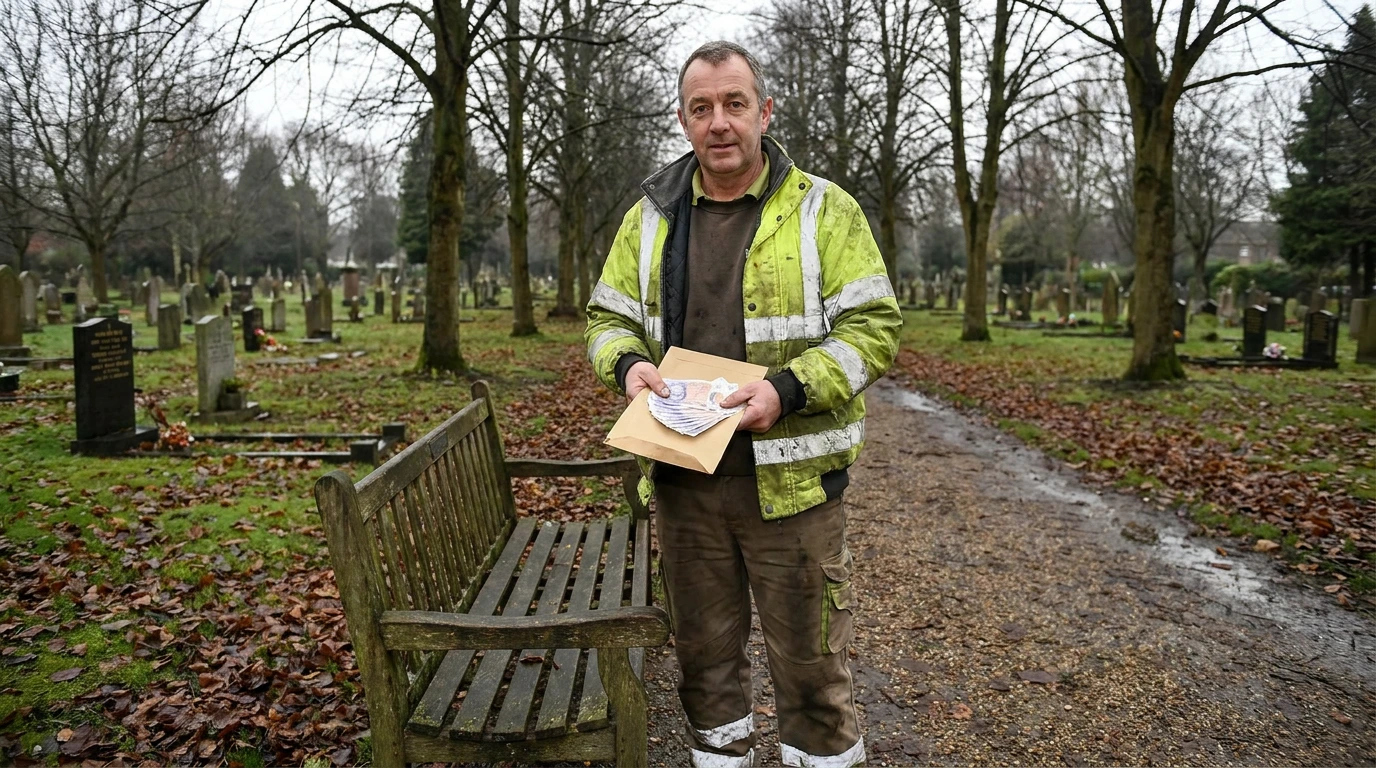
Chapter one
Beneath the Bench
Idris Rahman, the cemetery worker, did his round before the gates opened, when the paths belonged to foxes and to people who preferred not to meet anyone. He checked the locks, gathered windblown wrappers, and moved flowers from the drains before the next rain could turn the lower plots into a pond. At the oldest yew, a corner of brown paper showed beneath the bench. He nearly left it for the cleaner. Then he saw that somebody had weighted the envelope with a stone, as though they expected a storm or knew exactly when Idris would pass. The envelope beneath the bench held forty twenties, tied with blue cotton, and a burial order for the following morning. The name of the deceased was Idris Rahman.
It listed his age correctly, including a birthday only three weeks away. The signature at the bottom belonged to a doctor he had never heard of, and the plot number belonged to a grave he knew well: C-117, an old family space that had been empty since 1989. He felt the childish urge to put the order back and pretend the morning had happened differently. Instead he photographed both sides and put the original in the inside pocket of his work coat. The money stayed in the envelope. A forged death order was a matter for the police. The precise sum, and the stone set on top of it, made him think someone wanted the police to look in the wrong direction.
Idris had worked here for nineteen years. He knew which headstones leaned before winter, which widow would bring a flask and ask for help with the stiff gate, and which register had been bound so tightly it snapped shut on your hand. The paper register for Section C was that one. He opened it on the caretaker's desk and found six names on the line for C-117. Yesterday the line had been blank. The first name was dated 1989, the last was Mira Holt, whose burial time was marked as 2:17 a.m. tomorrow. Someone had copied the ink's brown fade so well that the names looked as old as the surrounding entries. He pressed his thumb to the page. It was still faintly tacky.
There was a scrape at the outer gate. A man in a grey facilities uniform stood beyond it, his gloved fingers curled around the bars. He had the politely tired expression of someone sent to fetch an item another department had lost. 'I'm looking for an envelope,' he said. Idris asked for a name and an authorisation number. The man glanced at the register on the desk behind him. 'It will only cause trouble if it stays here.' Idris replied that trouble had already arrived. When the man removed one glove to show an identity card, a black tattoo appeared on his wrist: the outline of a door without a handle. The card had a council crest but no photograph.
Idris kept the gate locked. The stranger offered to reimburse him for his time, naming eight hundred pounds without once asking how much the envelope contained. That was the first proof that he had placed it. Idris said he would hand it to the police. The man's face altered almost imperceptibly, as if a calculation had lost a favourable number. 'The burial is scheduled,' he said. 'There is paperwork to complete.' He stepped away before Idris could ask which burial. Rather than leaving by the road, he followed the boundary wall toward the old chapel, where the yew branches obscured the cameras. Idris watched until the grey had vanished into the green.
The ordinary thing would have been to call the police then. Idris did, and was told an officer would come after the morning briefing. The extraordinary thing was that the call history on his phone showed no call at all. He dialled again, spoke to a different operator, and kept her on the line while he wrote her incident number on his palm. When the conversation ended, the ink remained but his phone displayed only yesterday's missed calls. He tried to tell himself the device was faulty. A bell rang from the locked chapel, three clear notes. There had been no bell in its tower since the refurbishment five years earlier.
In the chapel basement he stored forgotten possessions in labelled archive boxes: a pair of gloves, a framed photograph, the ribbon from a wreath whose inscription had been lost in rain. Beyond the boxes stood a cabinet that should have held old coffin tags. It was full. Six tags bore the names in the register, printed with identical imperfections although their dates were decades apart. ELIAS KESTREL, 1989, appeared on the first. The reverse carried an address on Morrow Street and a pencilled instruction, ABOVE THE NEW CEILING. On Mira Holt's tag somebody had written HOLD UNTIL CONFIRMED. Idris turned it over twice, angry at the cold administrative language used for a living person.
A small object fell out of the cabinet: a child's brass whistle, the kind sold at seaside shops. He knew it before he knew why. He had carried one on a school trip in 1989, the year his father took him past this cemetery and would not say whom they were visiting. Idris blew it softly. The notes sounded thin and imperfect. From beneath the floor came an answer, one long and two short. His father had taught him that pattern so Idris could signal if he became lost in a crowd. After the school trip, no one at home had ever mentioned the whistle again. Idris had remembered carrying it, but not where it had gone.
He tried the basement door and found the handle would not turn. A second ago the chapel windows had been bright with morning; now they showed a line of yellow streetlamps. Through the stone floor he heard feet on gravel, a woman calling a child's name, then the dry metallic slide of a latch. He held the whistle so hard it cut a line into his hand. The sound stopped when he put the envelope of money against the floor. The light returned. The door opened easily. Idris went out into the sun and sat on the chapel step until his breathing was slow enough for him to count the notes again: forty, every serial number ending in B17.
At half past ten a young woman arrived with two others, asking for Section C before she had even closed the car door. Mira Holt was one of them; he recognised her from an old photograph clipped to the burial order, though in the photograph she looked considerably older. Mara Vale carried a brass key tagged B17. Nina Shah carried a pharmacy receipt whose date had not happened yet. They had the wariness of people who had compared impossible facts and decided to come anyway. A student named Jae remained in the car with a recorder and three backup copies of a ledger found in an open safe. Idris showed them his order. Mira read her name in the register without touching the page.
Mara told him about the coat in the laundrette, Nina's envelope at the pharmacy, and the gym locker that had vanished between B16 and B18. Idris did not believe every part of it. He believed the numbers on the money and the fresh ink on a thirty-year-old record. Jae brought in the ledger from the rented house. Its two columns had been labelled Before and After, but the after column held too many blank spaces to be a simple account of death. Six people appeared under C-117, each on a date when a crossing elsewhere had supposedly been closed. Mira's entry named tomorrow. Idris's was written in a different hand and marked tonight. Neither had a cause of death.
'It is not a grave,' Idris said. He remembered the maintenance plans from the chapel restoration: a drainage channel had once run below Section C, connecting the crypt to foundations under three demolished streets. When the contractor's plan changed, nobody knew why, but the channel had been sealed with a steel plate beneath C-117. The ledger's numbers might represent a crossing, as Mara thought, yet the cemetery records gave it another purpose. They turned an absence into a death. If a person disappeared from this city, a body could be claimed without anyone seeing one. A family could be told to stop looking. He thought of his father standing mute beside the road in 1989.
He led them to C-117. The plot had no stone, only flat grass bordered by gravel and the bench under the yew. Idris pressed a trowel into the turf and struck brass a hand's depth below. The plate had a keyhole shaped like the tag on Mara's key. It turned without resistance. Cold air moved out of the narrow channel, smelling of wet stone and something stranger, like rain on hot iron. From below came a door opening and shutting at regular intervals. Mira bent toward it. Jae pulled her back when her watch jumped forward from 11:06 to 11:07 and back again.
The grey-uniformed man was waiting at the end of the path. This time he had brought a small excavator driver who believed he was here to reopen an old service trench. Idris showed his work ID and cancelled the order. The driver, annoyed but practical, switched off the engine and left. The stranger did not argue. He looked at the envelope under Idris's arm. 'You could have put the money back,' he said. 'Nobody had to know.' Idris asked why a death order bore his name. 'Because you have already taken someone's place,' the man said. 'The accounting catches up, even if the person doesn't.' Then he touched the black door tattoo and the path between them seemed to lengthen by several metres.
Mara tried to follow him and arrived beside the same yew twice. Nina recognised the trick from the pharmacy: an hour that could be travelled in a circle while the outer world moved on. Idris put one of the B17 notes on the brass plate. The path straightened. The man in grey had gone, leaving a wet footprint on dry gravel. The note had changed; its serial number now ended in C17. Idris kept it separate. The rest of the money weighed the plate enough that the sound below became steady rather than intermittent. He understood that the notes were markers left at places where a choice had been moved between one version of the city and another. They did not buy life. They showed where someone had taken it.
At noon the officer finally came. Idris had the incident number on his palm and the forged order in a clear sleeve. The officer took the document seriously until her radio crackled. She asked him to repeat the name on the order. When he did, she looked at the page and found the name field empty. Mira saw it too; Nina's photograph, taken minutes earlier, still showed IDRIS RAHMAN. The paper was changing to suit a version of the day in which no offence had occurred. Idris asked the officer to write down precisely what she could see now, sign it, and date it. She did. The words remained on her notebook page even after she left.
By evening Idris had made seven independent records. He copied the register by hand; Jae recorded its pages with his camera and read the names aloud on audio; Nina sent the order photographs to her professional email; the officer had her signed account. None was infallible, but each had been made by a different witness at a different hour. The stranger in grey could change a source. Altering a city of witnesses would take more work. They could not keep vigil here and search Morrow Street at once. Mara argued for the building above the new ceilings. Idris told her he would hold the channel open through the night. He was frightened enough to be exact: she must call him at every site, and if he stopped answering, she should not come back alone.
When the others had gone, Idris walked Section C again. He checked the locked gate, the chapel window and the bench, because routine could steady a hand as well as any brave speech. At 2:17 a.m. the channel spoke his name in a boy's voice. He recognised his own accent from old family tapes, before he had learned to make it less noticeable at school. 'Don't let him shut it,' the boy said. 'Dad is still looking.' Idris held the envelope against the brass. All his life he had believed he was the boy who came home from that trip. The voice beneath the grass knew a different ending.