
AN ILLUSTRATED SHORT STORY · 01
A Laundry Worker Finds a Bundle of Cash in Someone Else’s Coat
During a night shift, Mara Vale finds a wet blue coat in an empty washing machine. In its pocket are banknotes totalling £250,000 and a pharmacy receipt dated the following day. Her brother Lewis disappeared from the same street months earlier, and Mara has stayed at the laundrette hoping its cameras might help her find him.
Then the security monitor shows something that has not happened yet: a man approaching Mara to take the money. Following the receipt could bring her closer to Lewis, but someone is already trying to recover the evidence. This crime mystery contains a fantastical element: the clues cross between the present and the future.
Read chapter one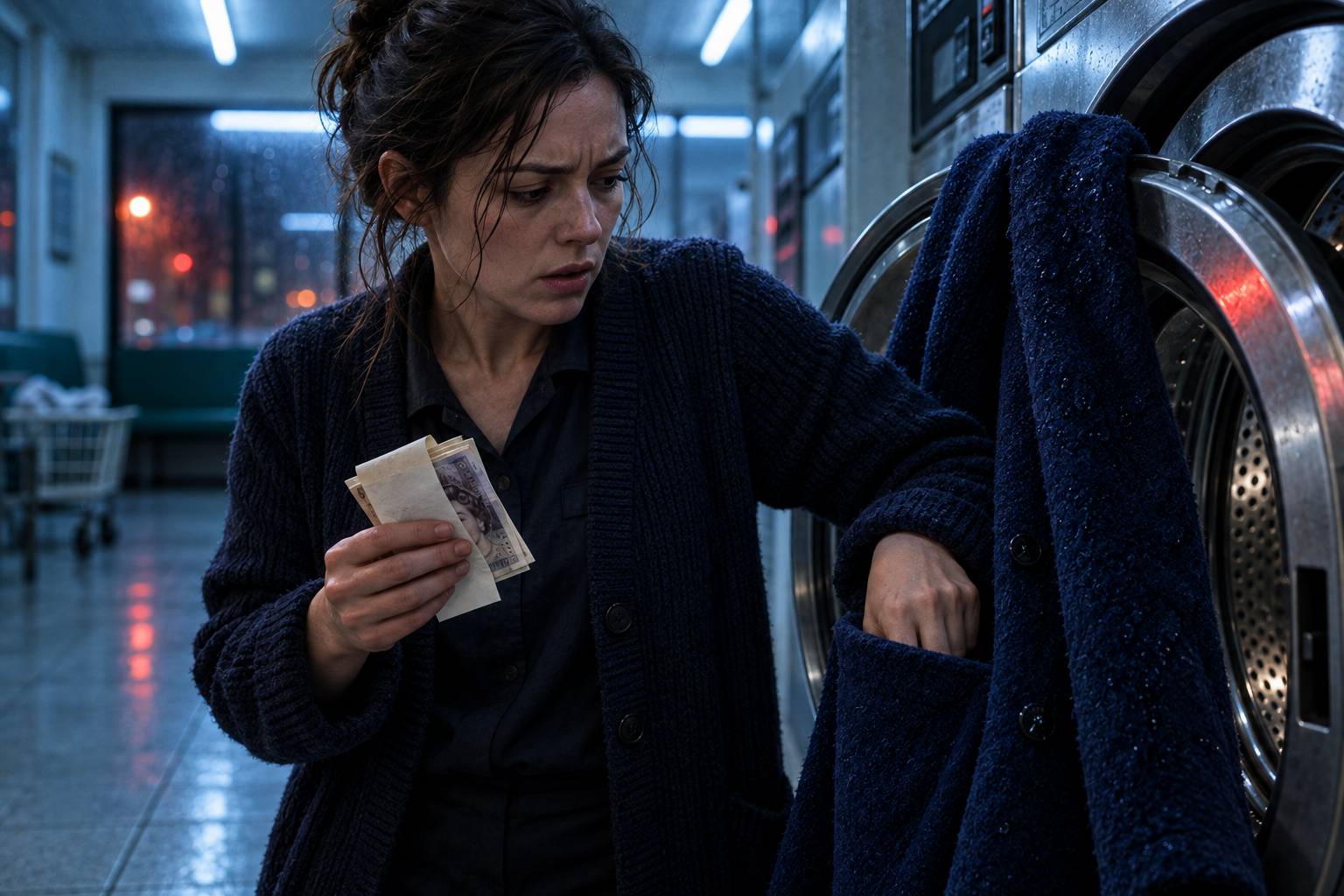
Chapter one
The Coat
Mara Vale had worked the night shift at Bell Street Laundrette for eleven months, which was long enough to know the building's small noises by name. The dryers had a low, tidal breathing. A pipe above the change machine knocked three times whenever the upstairs tenant ran a bath. Even the security camera clicked when it changed from colour to infrared. At 2:17 on a wet Thursday morning, every machine stopped together. The pipes went quiet. From inside machine six came three deliberate knocks. Mara looked up from the book of crossword puzzles she had been failing to finish all week.
She had locked the doors at midnight, leaving only the service entrance open for collection drivers. The last customer, a taxi driver called Omid, had carried two shopping bags of warm washing into the rain at one thirty. Now a dark blue coat lay across the open drum of machine six. It was the wrong size for Omid and too good for anybody who used Bell Street at night: heavy wool, satin lining, one cuff professionally darned. Mara picked it up by the collar. Water seeped through her fingers, though nothing in the drum was wet. In the pocket of the stranger's coat, at the laundrette, she found a thick bundle of banknotes tied with a pharmacy receipt.
The banknotes were old enough to have softened at the corners but clean enough to show the raised print. Together, they came to £250,000. The receipt bore the name Calder Pharmacy, an address two streets away and tomorrow's date. Somebody had written B17 across the back, then scored it out so hard the paper had almost torn. Mara set the money down. Her first thought was the police. Her second was that the police would ask why the security feed had been disconnected twice in the past month. Her employer had blamed a faulty router; Mara knew someone had cut a cable with a blade.
Her younger brother Lewis had vanished from that same stretch of Bell Street in March. The police called it a voluntary disappearance. He was twenty-six, had debts and an untidy flat, and his last recorded transaction was a bus fare out of town. Mara had found his passport beneath his bed and a birthday card he had written to their mother but never posted. She had continued the night shifts because he had once said the laundrette's cameras pointed at the mouth of the old railway tunnel. He had sounded frightened when he told her. It was one of the last conversations she could bear to replay.
The number on the receipt was the pharmacy's ordinary landline. Mara dialled it on the shop phone. A woman answered before the first ring finished, breathless and close to tears. 'Do not spend it,' she said. 'The money is a marker.' Mara began to ask who she was. 'Look at the screen. Then get away from the front door.' The line died. On the security monitor, Mara saw herself at the counter, holding the same bundle. The timestamp read 2:23. Blood ran from a fresh cut on her knuckle. Behind her stood a man in a grey maintenance uniform, reaching for the money. The real clock above the detergent shelf still read 2:19.
Mara dropped behind the counter. When she looked up, the recorded version of herself moved too: it thrust the cash into an open till and slammed it shut. She had seen delayed video feeds before, but this could not be a delay. The monitor showed her future, and in that future she looked directly into the camera. Her mouth formed a word. Mara leaned close enough to fog the glass. The future Mara said, 'Lining.' Then the image broke into snow and returned to the empty row of machines as they stood now.
She took the coat into the storeroom, locked the thin door and felt along every seam. The lining had been opened and closed with blue thread that did not match the black stitching. Inside was a little brass key, its tag stamped B17, and a narrow strip of photographic negative. Against her phone's torch the negative showed six doorways arranged like frames on a contact sheet. The last doorway was a plain blue rectangle. The first was the laundrette's service entrance. Beside it, almost too small to see, stood a boy with Lewis's bent shoulders and distinctive white trainers.
The front bell rang at 2:23. Mara counted one breath, then another. Through the storeroom's wired-glass pane she watched a man in a grey uniform cross the shop without glancing at the machines that had stopped. A black tattoo on his wrist outlined a door without a handle. He went to machine six and put one arm into the drum, beyond the depth the drum should have allowed. When he withdrew it, he held a second bundle of notes. He inspected the first serial number and spoke into a radio. 'Packet one is missing. The line is still open.'
Mara's phone vibrated. The number had no caller ID. A text appeared: DON'T LET HIM TAKE BOTH. She had her packet. The man had another. If the text was from the woman at the pharmacy, she somehow knew both details. Mara pressed the call icon; the screen read No Service. Across the shop the man asked, very politely, whether anyone was there. His boots made no sound on the tiled floor. Mara saw his face in the convex mirror above the door: narrow, pale, with a neat cut behind the ear. He was looking straight at the storeroom.
Instead of opening the door, he sat on a plastic chair and waited. The ticking of the wall clock came back, louder than it had ever been. Mara realised that his patience was a test. He could block the street door, but the service entrance behind her opened on the delivery alley. She slid the bolt and stepped out into rain. The alley smelled of wet cardboard and diesel. A train sounded beneath the pavement, although passenger trains had not used the old tunnel since the eighties. A small light appeared where the brick wall met the ground.
A slot no bigger than a letterbox opened in the bricks. Through it Mara saw the back of her own head, inside the shop, as clearly as if a second storeroom existed on the other side. That version of her wore the blue coat and held the packet over an open till. The grey man rose from his chair. Mara called out a warning, and her other self paused. A violent shiver travelled along the alley wall. For one awful instant Mara remembered two incompatible things: running from the shop and staying to confront him. Then the slit snapped shut, leaving a rectangle of dry mortar where it had been.
She reached the main road before she stopped. Calder Pharmacy was dark, its shutters half drawn. In the window, a poster invited customers to bring unwanted medicines for safe disposal. A woman with a green umbrella stood by the bus stop, her face hidden. Mara wanted to ask whether she had called. The woman crossed at the light without looking up and vanished behind a delivery van. It was ordinary enough to make Mara mistrust it. When her phone acquired a signal, there was no text in her messages, incoming or outgoing. The cash remained real in her coat pocket.
She went home to the small flat she shared with her mother and did not wake her. On the kitchen table lay Lewis's unopened birthday card. Mara took out the notes and copied the serial numbers into her crossword book. Their prefixes differed, but every number ended in B17. The last note did not. It ended in B16. As she watched, the final character of its number darkened, the bottom loop of the six closing into a seven. She rubbed at the ink until her thumbnail hurt. It did not smear. She folded the note away from the others.
At seven, a detective she knew from Lewis's case answered his desk phone. Detective Constable Harrow listened while Mara described the coat, the cash and the man in grey. She left out the impossible monitor. Harrow said a bundle of stolen notes could be evidence and agreed to meet at the laundrette. Half an hour later he called back. There was no Bell Street Laundrette in the station's current business directory, he said, and the camera footage from that address had been lost in an overnight system error. Mara held the phone away from her ear and looked at her wage slip. It still named Bell Street Laundrette Limited.
On the bus back she read the photograph strip more carefully. The doorways were not places so much as moments: the laundrette at 2:17, the pharmacy's counter at 2:17, a row of gym lockers, a garage with an open safe, a cemetery bench and the blue rectangle. In the margin beside the first frame Lewis had scratched a mark that looked like a crooked L. She recognised it from his school exercise books. He had drawn it whenever he meant to say something privately. The mark did not tell her where he had gone, but it meant he had been here alive.
The laundrette stood where it had always stood. Its sign had been replaced with one advertising a vacant unit. Inside, the machines were unplugged, covered in plastic and dusted as if they had been unused for years. Mara's key opened the front door. A property agent had left a notice giving the date of a viewing next week. She checked the calendar on her phone three times. Next week had already passed. In machine six she found a folded sheet from the police missing-person register. LEWIS VALE, it read, CASE CLOSED: FOUND DECEASED. The date of discovery was tomorrow.
Mara sat on an overturned detergent crate until her hands stopped shaking. The sheet carried no signature and no description of a body. She could take it to Harrow, but a file that would not exist until tomorrow would only make her sound ill. At the bottom somebody had written a location: Service tunnel, access B17, 02:17. A second line, in smaller print, warned: DO NOT REMOVE BOTH ANCHORS. She laid the two bundles side by side on the counter. The packet taken from the coat contained £250,000. The second packet, still with the man in grey, could close whatever crossing Lewis had found.