
AN ILLUSTRATED SHORT STORY · 03
An Envelope of Cash Is Found in a Gym Locker
Mara Vale and pharmacist Nina Shah visit a gym to follow clues from their earlier encounters with unexplained cash. A brass key opens a blue locker containing an envelope of banknotes, a floor plan and a warning that only one person may leave with the plan.
In the changing-room mirror, Nina sees a woman who is absent from the room itself. A member of staff identifies her as Saira, a missing employee. The plan may show how to reach her, but a man arrives looking for it. This fantastical crime mystery follows Mara and Nina as they try to help Saira without surrendering the evidence.
Read chapter one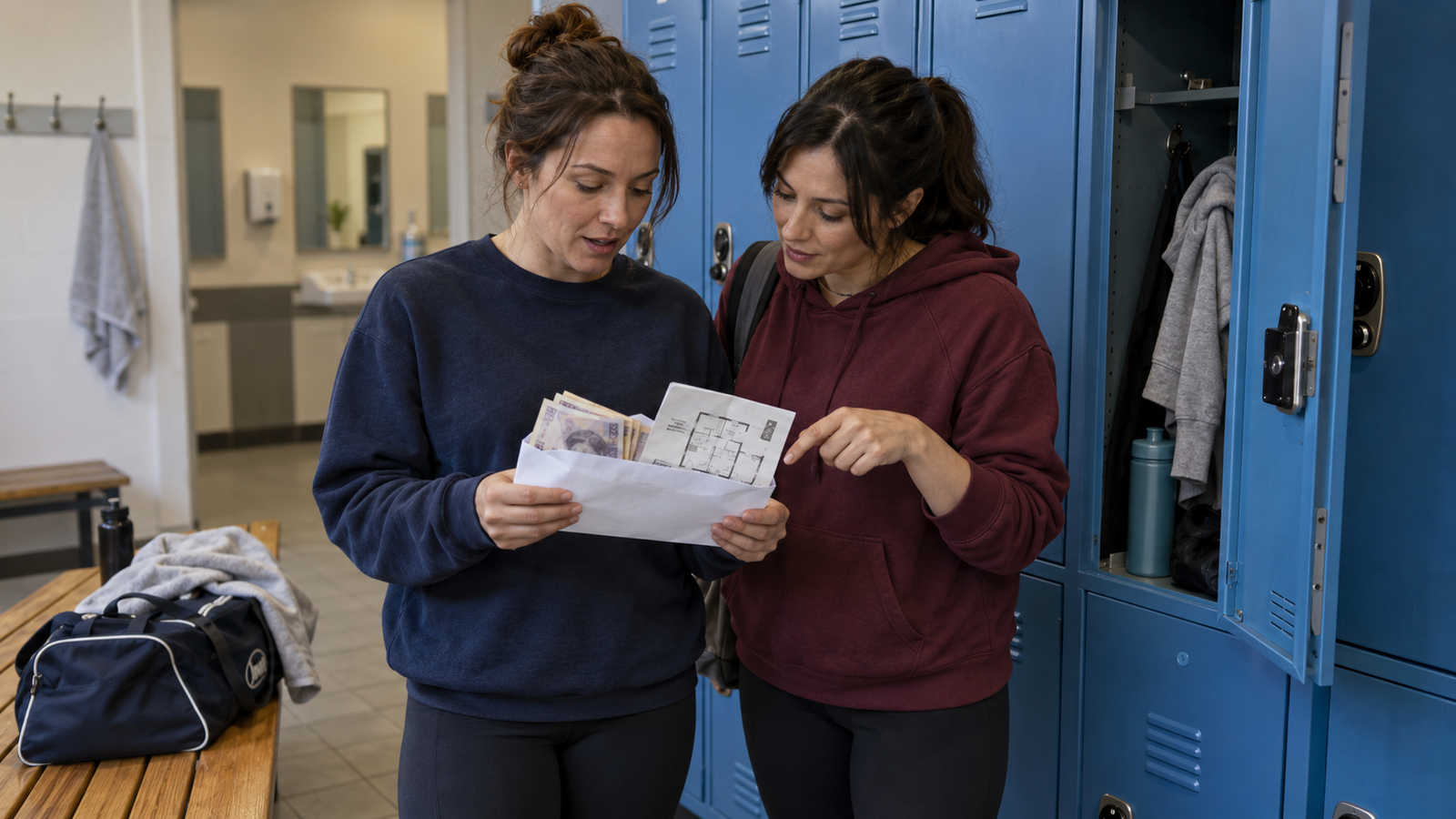
Chapter one
Locker Seventeen
The gym had been built over a railway tunnel that no train used any more. Nina could feel it through the soles of her shoes: a faint vibration under the tiled lobby, as if a great machine were running far below them. Mara said it was probably the dryers at the laundrette still turning in her head. Neither laughed. They had met less than two hours earlier, each carrying proof of a night the security cameras insisted had not happened. Nina had six photographs in an envelope; Mara had a brass key marked B17 and a bundle of banknotes she refused to put in her own pocket.
They bought day passes at the desk. The receptionist, a young man with a plaster across his eyebrow, asked Nina to sign a waiver. He gave Mara hers without looking up. When she read the date beside her signature, she slid the paper back. It was tomorrow's date. He stared at it for a moment, tore off the bottom of the sheet and wrote today's date in pen. "Printer does that sometimes," he said. His voice was too rehearsed for a broken printer. Mara noticed that he watched the revolving doors until they were through them.
The changing room was almost empty at eleven in the morning. Steam came from the showers, although no taps were running. Lockers B01 to B16 stood in one row, painted a weary institutional green. B17 had a fresh blue door. B18 and B19 were green again. Nina took out her phone and photographed the whole wall before Mara put the key in the lock. The screen showed a blank strip of plaster where B17 ought to have been. She lowered the phone. There was still a door, with a brass key turning in it. On the image, the plaster was narrower than a locker. They had both seen impossible things by then, but this one made Nina's stomach tighten in an ordinary, animal way.
Inside lay an envelope of money, fifty-pound notes in a paper band, and a floor plan folded four times. There was a note on top: ONE PERSON MAY LEAVE THIS ROOM WITH THE PLAN. The lettering had been done with a thick black marker, each word pressed hard enough to dent the next sheet. Beneath it someone had added, lightly, in pencil: That is what he wants you to think. Mara examined the pencil marks. She had seen the same hand on the back of the laundrette receipt. The money was dry, but the inside of the locker smelled of rain.
"We take the plan together," Mara said. She did not touch it yet. Nina looked at the mirror opposite the lockers and saw a woman in a pale cleaning tunic standing at the showers. The woman lifted one hand. Nina turned and found the stalls empty. In the mirror, the woman remained. Her mouth moved. Nina stepped closer until she could make out the words. "Don't let him count me." A door banged behind them. The reflection emptied, and water began to run from every shower at once.
The floor plan showed a detached house at the city's northern edge. A garage occupied the length of its west wall. Nina had looked up the address before they came: the letting photographs showed a wall of ivy where a garage should be. In the plan, a heavy square marked SAFE stood in the garage corner. Six small circles were drawn between it and the street. B17 was written beside one circle; the other five were untitled. On the back was a booking confirmation for four students arriving that afternoon. It included a phone number and an instruction in the same pencilled hand: KEEP THE SAFE OPEN.
A man cleared his throat in the doorway. His gym polo had MANAGER embroidered above the pocket; his badge said RAFIQ. He looked at the open locker, then at Mara's key. "That belongs to a member," he said. His eyes gave away the rest: the member had not been here for some time. Nina showed him the photograph on her phone. "Does this locker exist?" Rafiq stared at the blank wall in the picture. His colour changed, and he asked them to come into his office. When Mara declined, he said, "Then close it. Please. I have staff who come through this room."
He was afraid for someone, not merely afraid of a strange door. Mara asked who the cleaner was. Rafiq's hand went to his badge. "We have three cleaners." Nina described the woman in the mirror. Rafiq's expression broke before he could hide it. "That was Saira," he said. "She went missing last winter. Police took a statement. Then they came back and told me I must have remembered it wrong. There was no Saira on our payroll. I had signed her timesheets for eleven months." He rubbed at the adhesive on the edge of his badge. "I kept a copy. Every morning the name looks different."
In his office, he showed them a photograph taped inside a drawer. A woman in a pale tunic grinned beside a Christmas tree made of folded towels. The caption underneath said SAIRA KHAN, STAFF PARTY. As Nina leaned in, the first name blurred. She pulled her phone out and photographed the print. Her screen showed the woman clearly, but the caption now read STAFF PARTY, no name. Rafiq shut the drawer so quickly that it caught his thumb. "She had a daughter," he said. "I called the number on her emergency form. A little girl answered and said her mother was at work. The following day the number was disconnected."
Nina thought of the woman who had left the money at the pharmacy counter: her own face, older, frightened, trying to buy an hour for someone else. She laid the photographs out on Rafiq's desk. In the oldest, before the gym existed, a woman stood in front of a boarded station entrance. Behind her shoulder was a blue rectangle like a door. In another, dated last winter, Saira pushed a mop bucket past a row of lockers. The person reflected in the glass behind her wore grey. At his wrist a black door had been tattooed without a handle. Rafiq recoiled. "He came to ask whether she'd left anything behind," he said. "The day before she vanished."
They returned to B17 with Rafiq's copy of the timesheet and an agreement: they would try to find Saira, but nobody would step through a door they could not see both sides of. Mara counted the notes in the envelope. There were twelve, all fifty pounds. The serial numbers ran in order except for the last, which ended B17. Her laundrette bundle had a note with the same ending. As she held both notes beside the mirror, the reflection deepened. Beyond the shower stalls was a second changing room, older, with blue tiles and a clock stopped at 2:17. Saira was there, gripping a mop handle like a railing.
"Can you hear me?" Nina called. Saira's lips moved. The showers roared too loudly. Rafiq shut the taps at the wall, but the sound went on. Mara put the laundrette note back in her pocket. The older room faded. She held it up again, and Saira returned. Nina understood enough to make a dangerous guess: the notes were markers, not fuel, but together they kept a record of a place that had split. Someone had moved money through that place and left a trail. If the trail were taken away, the seam might close with Saira on the wrong side.
Rafiq opened the paper locker register. There were two entries for B17 that morning. One was Mara's name in a neat hand, though she had never signed for a locker. The other read G. KESTREL, VISITOR. Beside it was an appointment time of 11:17. The second hand of the changing-room clock struck the minute. From the lobby came the scrape of the revolving door. A man in grey passed the frosted glass, moving with the unhurried confidence of someone expected. Rafiq whispered that he would call the police. Nina told him to call anyway, but to say a woman was trapped rather than describe how.
The grey-uniformed man arrived carrying a slim canvas bag. He looked first at the money. "The manager was asked to report found property," he said. Rafiq squared his shoulders. "I was asked about a former employee. I reported her missing." The man gave him a sympathetic smile. "Memories are poor evidence, Mr Nasser." Mara felt the sentence settle on the room like dust. She had heard officials say worse things more politely. She held up Saira's Christmas photograph. "What is she? A memory?" The man did not glance at it. He looked at the brass key in Mara's hand.
"There has been an accounting error," he said. "The packet in the locker is needed to put it right. You may keep whatever else you've found." His hand closed around the note in his bag, which was marked B17 at one corner. Nina stepped between him and the open locker. In the mirror, Saira put both palms against the glass. It did not give. The man said, "She can hear you. Do you know how long she's been hearing people she cannot reach? You are keeping the wound open." For an instant, Nina wondered if taking the money away could be mercy. Then Saira shook her head sharply and held up a child's photograph.
Mara pulled the folded plan from the locker and looked at the note again. ONE PERSON MAY LEAVE THIS ROOM WITH THE PLAN. A rule written by the people collecting the packets was no rule at all. She tore the plan along an existing fold, passed half to Nina, and slipped the other half inside her coat. The man lunged, not for the notes, but for the paper. Nina ran towards the lobby; Mara ran for the fire stairs. Rafiq grabbed the man's canvas bag and held it long enough for them to leave by different doors at the same time.
The stairwell carried Mara down three flights where there should have been one. A bricked window looked out on a railway platform lit by a winter morning. A train stood at it, its doors open, its carriages empty. On the opposite wall, in water that ran upwards, a child's drawing appeared: a house, a square garage, a red line leading to a cemetery. Mara closed her eyes, touched the rough brick, and counted the steps back up. When she reached the landing, the window was ordinary glass and the view was of a car park. Her phone said 11:18. Its map said she was a mile north of the gym.
Nina came through the revolving doors into a lobby she recognised, except that the noticeboard listed a swimming pool the building had never had. Rafiq was at reception, calmly explaining membership prices to an elderly customer. He did not recognise her. The photograph of Saira on Nina's phone remained, but the caption had gone and the face looked less clear each time she glanced away. Nina walked outside, called Mara, and heard her answer from somewhere underground. "I'm coming back," Mara said. "Don't let them close it." Nina looked at the half plan in her hand. The ink at the safe had turned red.